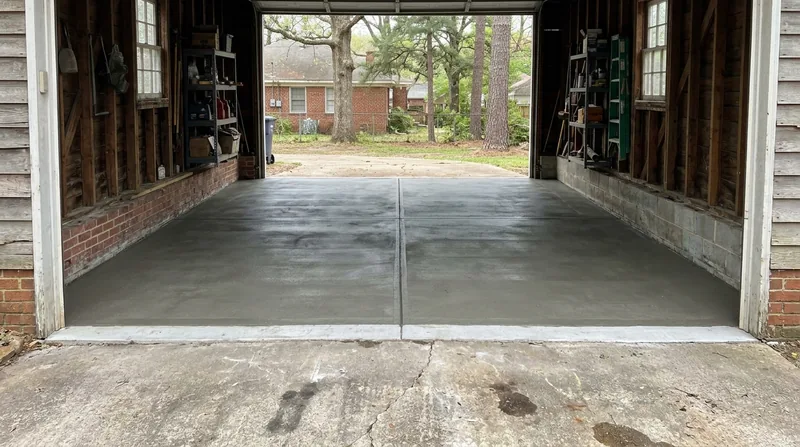




A garage floor in Little Rock takes a beating. Whether you're parking a truck in Hillcrest, storing tools in Pleasant Valley, or running a small operation in Chenal Valley, your concrete floor handles oil drips, temperature swings, moisture from our wet springs and summers, and the occasional salt-tracked freeze. Little Rock sits where the Ouachita foothills meet the Delta plain, which means our soil shifts with the seasons. Shrink-swell clay on the south and east side heaves when wet and cracks when dry. Your garage floor needs a firm compacted base, proper reinforcement, and well-cut control joints to stay level and crack-resistant for decades. We pour and finish durable garage floor slabs that resist staining, moisture, and daily wear, with a smooth trowel or broom finish sealed to protect against the Arkansas climate.
Why Garage Floors Matter in Little Rock's Diverse Neighborhoods
Little Rock's residential stock ranges from Victorian and Craftsman homes in the Quapaw Quarter and Hillcrest, where detached garages sit on steep driveways, to mid-century brick ranches in midtown, and newer two-stories in Chenal Valley with three-car garages sloped to handle runoff. Every garage floor faces the same environmental pressures: 90-degree summers with heavy humidity that accelerate concrete curing, about 50 inches of rain annually testing drainage on hillside lots, and winter freeze-thaw cycles that can crack an undersized or poorly finished slab. A properly constructed garage floor protects your home's foundation, prevents water intrusion into the garage structure, keeps oil and chemical stains from setting in, and gives you a safe, level surface for vehicles and storage for decades.
- We excavate and compact the subgrade to eliminate soft spots and settlement risk on clay-heavy lots.
- We place a compacted gravel base and lay reinforcing steel or wire mesh to resist cracking from shrink-swell movement.
- We pour a 4-inch slab minimum and finish it smooth or with a light broom texture for traction and durability.
- We cut control joints at 6- to 8-foot intervals to direct cracks into planned channels and keep your floor looking neat.
- We seal the finished floor to repel oil, moisture, and salt spray from winter weather.
A well-built garage floor is an investment that pays back in safety, resale value, and years of trouble-free use.
Key info: Little Rock's river-plain clay on the south and east side is notorious for heaving and cracking. Homes in Pleasant Valley, West Little Rock, and lower midtown need extra attention to base prep and joint spacing. Hillcrest and Heights lots with rocky shale and thin red clay are more forgiving but still benefit from proper compaction and reinforcement.
For more information on protecting your concrete investment, see our concrete sealing services to extend the life of your floor.
How We Build Garage Floors That Last in Little Rock
Our process starts with a site assessment. We evaluate your soil type, drainage patterns, existing grades, and any utility lines or setback requirements. On clay-heavy lots, we may recommend a thicker base or additional reinforcement. We then schedule the pour at a time that avoids heavy rain forecasts and temperatures below 50 degrees or above 85 degrees at pour time, because both extremes slow curing and can weaken the concrete. We work fast and clean, finish to a smooth or broom-textured surface, and seal the floor to lock in durability.
- We confirm property lines, utility locations, and any local setback or width requirements with the city before we dig.
- We excavate to the correct depth and compact the subgrade in 4-inch lifts using a plate compactor or vibratory roller.
- We lay a 4- to 6-inch gravel base, compact it, and add reinforcing steel (rebar) or welded wire mesh on 12-inch centers.
- We set forms to grade, pour a 4-inch concrete slab, and finish it with a steel trowel or broom for the texture you want.
- We cut control joints every 6 to 8 feet and allow 7 days of curing before you park or load the floor.
- We apply a penetrating sealer to repel oil, moisture, and salt.
From excavation to sealed finish, a typical single-car garage floor takes 3 to 5 days, including curing time.
Example: A homeowner in Chenal Valley had a 500-square-foot garage floor that was cracked and settling unevenly on a sloped lot. We removed the old slab, built up the low end with compacted fill and gravel, poured a new 4-inch slab with extra rebar, and sealed it. The new floor is level, crack-free, and handles both vehicles and seasonal moisture without issue.
If your garage needs repair instead of replacement, our concrete repair and resurfacing service can restore a worn or cracked floor.
Garage Floor Methods and Finishes
| Approach | Description | Best for |
|---|---|---|
| Standard Trowel Finish | Smooth steel-troweled surface that sheds water and oil easily, minimal texture. | Most residential garages, easy cleaning, professional appearance. |
| Broom Finish | Light brush texture applied before the concrete sets, provides slip resistance without being rough. | Garages with vehicles, shops, or areas where traction matters in wet weather. |
| Polished Concrete | Multi-stage grinding and polishing to a high-gloss or matte shine, sealed to lock in durability. | Showroom garages, high-end homes, or spaces where aesthetics and easy maintenance are priorities. |
| Sealed and Epoxy Coated | Base slab finished smooth or broom, then sealed with penetrating sealer or topped with epoxy for extra durability and stain resistance. | Heavy-use garages, workshops, or homes where oil and chemical resistance is essential. |
Garage Floors Cost in Little Rock: What to Expect
A new garage floor slab in Little Rock starts at around $5 per square foot for a basic 4-inch poured slab with standard trowel finish and sealing. A typical single-car garage is 300 to 400 square feet, so you're looking at a base cost of $1,500 to $2,000. A two-car garage (600 to 800 square feet) runs $3,000 to $4,000. However, several factors move that number up: soil type and subgrade prep on clay-heavy lots require extra compaction and base material; sloped or uneven terrain means more excavation and fill; proximity to utilities or setback requirements may limit access; and upgrade finishes like polished concrete or epoxy coating add $2 to $5 per square foot.
We recommend getting two or three estimates from fully insured contractors so you can compare scope, materials, and timeline. Our free estimate includes a site walk, soil assessment, and a detailed quote with no obligation to book. Call (501) 214-4504 or visit our pricing page for more detail on what drives costs in your neighborhood.
Garage Floors Near Me: What Little Rock Homeowners Should Know When Hiring a Contractor
Choosing the right contractor for your garage floor is about more than price. You want someone who understands Little Rock's clay, knows the city's permit requirements, and stands behind their work with proper insurance. Before you sign a contract, verify that the contractor carries general liability insurance and workers' compensation coverage on every job. Ask for a current certificate of insurance so you're protected if something goes wrong on site. Get at least two or three estimates so you can compare scope, materials, timeline, and price. Check references from recent jobs in your neighborhood, Benton, Bryant, Sherwood, or Conway. Ask about warranty on the slab and sealer, and confirm that the contractor will handle any local permits and setback requirements. If you're in an HOA community, verify that the contractor understands your HOA rules and will coordinate with the architectural committee if needed.
- Request proof of current general liability and workers' compensation insurance before work starts.
- Ask for references from three recent garage floor jobs in your area and follow up with at least one.
- Confirm that the contractor will pull any required permits and handle setback or right-of-way compliance.
- Get the estimate in writing with a detailed breakdown of materials, labor, timeline, and finish options.
- Verify the warranty on the slab, sealer, and workmanship so you know what's covered if issues arise.
A professional garage floor contractor welcomes these questions and is happy to show proof of insurance and provide references. If someone resists or avoids answering, move on to the next estimate.
Ready to get started? Contact us for a free estimate and let us show you how we build garage floors that last.
Garage Floors in Little Rock: Pricing Guide
| Service | Price | Details |
|---|---|---|
| Standard Garage Floor (4-inch slab, trowel or broom finish, sealed) | Starting at $5/sq ft | Includes excavation, compacted base, reinforcing steel, control joints, and penetrating sealer for a residential single-car or two-car garage |
| Garage Floor on Clay-Heavy Soil (extra base prep, increased compaction) | Starting at $6/sq ft | South and east side Little Rock lots with shrink-swell clay require thicker gravel base, additional compaction, and closer joint spacing to resist heaving |
| Polished or Epoxy-Coated Garage Floor | Starting at $7-$10/sq ft | Multi-stage finishing with polishing or epoxy topcoat for durability, stain resistance, and high-gloss or matte aesthetic in showroom or high-use garages |
| Removal and Replacement (old slab demo and new pour) | On estimate | Scope depends on slab size, depth, reinforcement type, and site access; requires on-site assessment before pricing |
| Travel | Included | No mileage fee or travel charge for Little Rock, North Little Rock, Conway, Benton, Bryant, Sherwood, Maumelle, Cabot, and surrounding service areas |
| Free Estimate | Free | On-site assessment, soil evaluation, and written quote with no obligation to book; response within 24 hours at (501) 214-4504 |
Indicative pricing, the exact cost depends on square footage, finish, and site access. Free personalized estimate within 24h at (501) 214-4504.


